
Retaining Walls & Concrete Borders in Fulshear, TX
Gravity is undefeated. It has never lost a match, and it never will. Left alone, a slope of loose soil will eventually go wherever gravity wants it to go, usually straight into your neighbor’s yard, your pool, or the bottom of a drainage ditch after the first big storm. A retaining wall is one of the few things on a property that actually wins an argument with gravity, at least for a few decades at a time, as long as it is built the right way.
Churchill Concrete builds walls and landscape borders for homes and businesses across Fulshear and the nearby communities of Katy, Richmond, Rosenberg, Sugar Land, Simonton, and Brookshire. This page is about two very different jobs that both happen to use the same material: one holds back tons of soil, and the other just keeps your mulch where it belongs.
Why a Mostly Flat Town Still Needs Walls
Fulshear doesn’t exactly scream “mountain terrain.” Most of it is gently rolling farmland turned into subdivisions, and you’ll not find a dramatic hillside anywhere close to town. So it is a fair question: why would anyone around here need one of these structures at all?
The answer shows up in the details rather than the big picture. Many newer neighborhoods, including areas near Flewellen Creek and the drainage channels that run through communities like Cross Creek Ranch, include graded slopes leading down to ponds, creeks, and detention areas built specifically to manage stormwater. Those slopes need something to hold them in place, especially where a patio, a pool, or a flower bed sits close to the edge. Add in raised patios, terraced garden beds, and pool decks built a step above the surrounding yard, and the need for a wall becomes obvious even in a town without a single real hill.
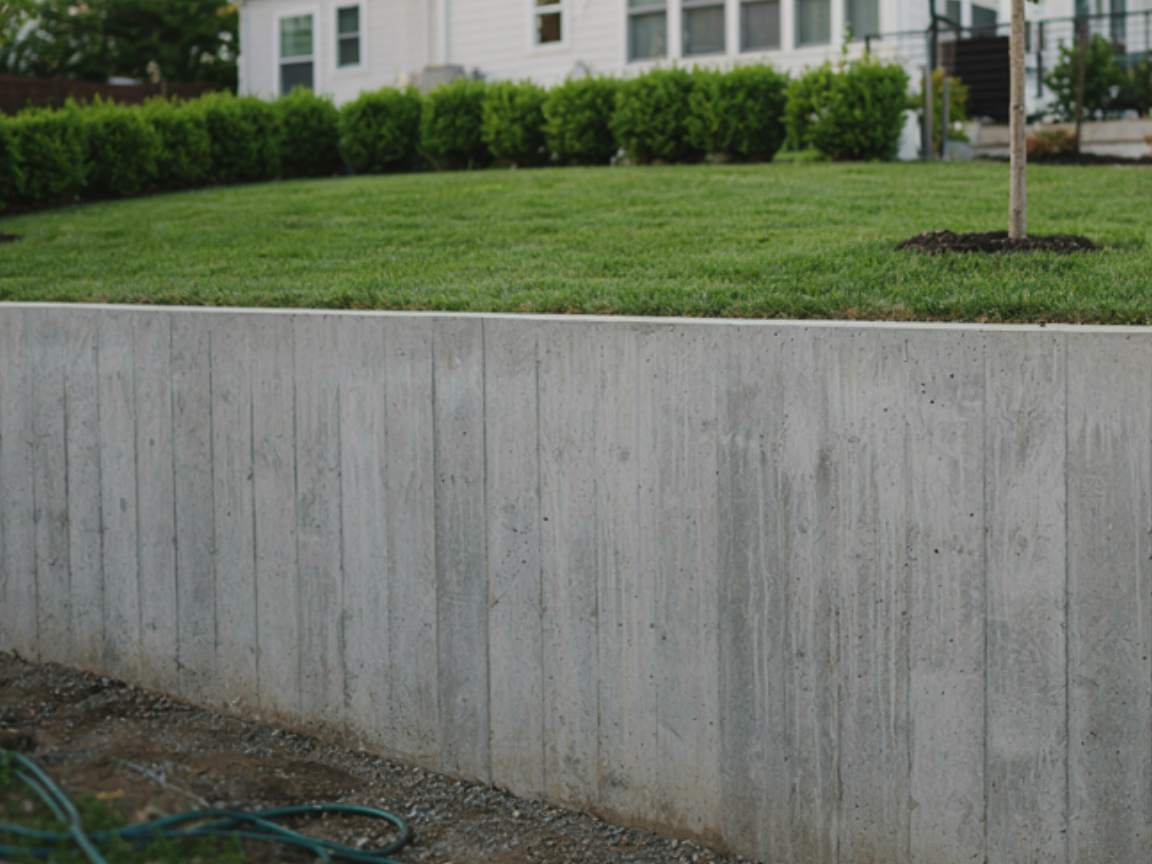
There’s also a quieter, less dramatic version of this problem: simple erosion. A property with even a gentle slope, combined with our area’s heavy seasonal rainfall, can lose a surprising amount of soil over the years as water runs downhill and carries dirt with it. A structure like this interrupts that slow drift before it turns a nicely sloped backyard into a series of awkward ruts and exposed roots.
Poured Concrete Versus Block: Picking the Right Approach
Not every backyard wall needs to look the same, and the right construction method depends on height, budget, and the look you are going for.
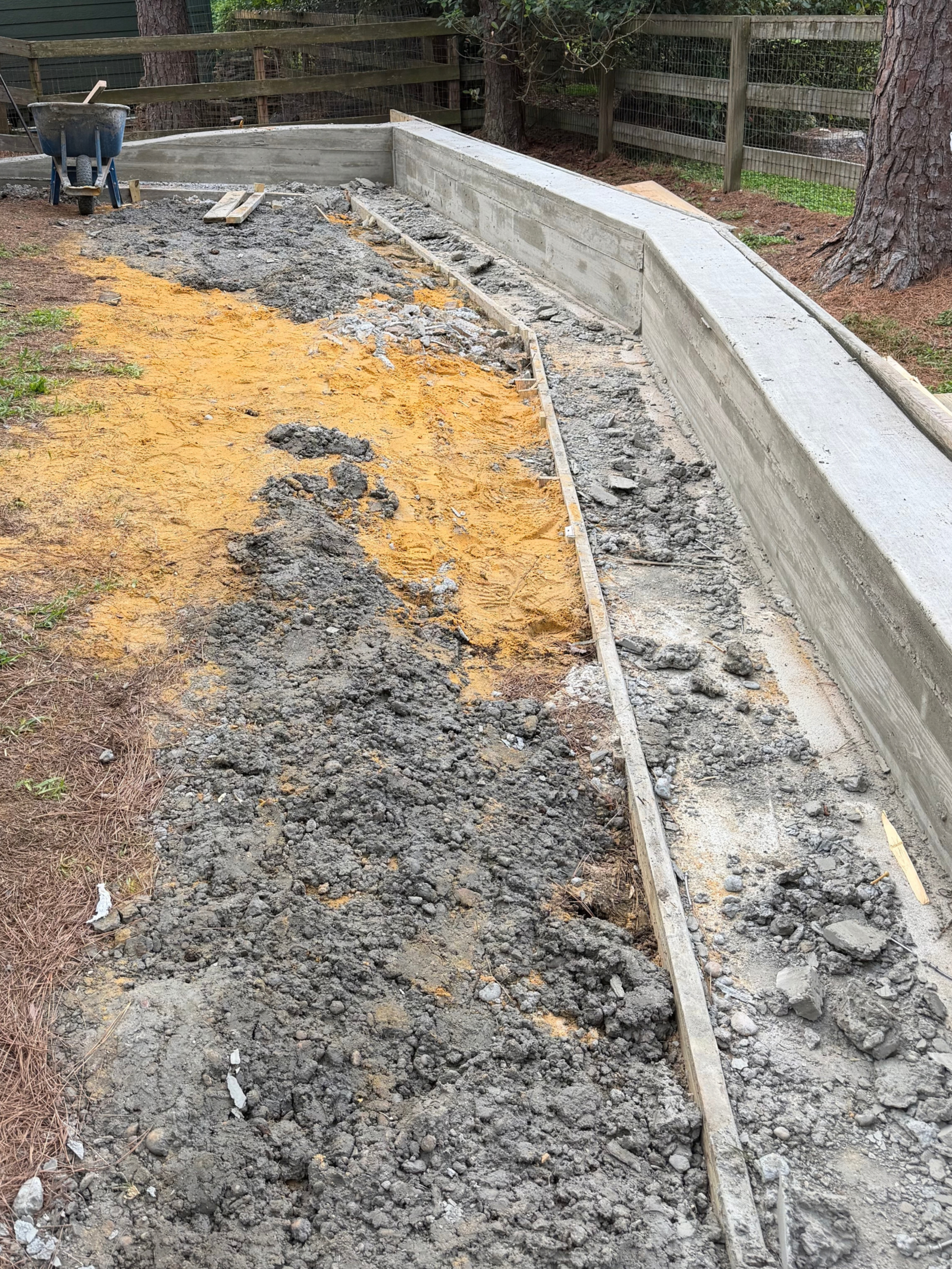
Poured concrete offers the most raw strength for its thickness, which makes it a strong choice for taller walls or ones supporting significant weight, like a driveway or a parking area above the slope. They can also be finished in a variety of ways, including stamped textures, integral color, or a stone veneer applied afterward, so “poured concrete” does not have to mean plain gray.
Segmental block systems, built from individual interlocking concrete units, offer more flexibility in appearance right out of the box, with a wide range of textures and colors available without any additional finishing work. They also tend to install a bit faster for shorter walls, since there is no waiting on concrete to cure before the next step happens.
The tradeoff is that block construction generally has height limits before it requires additional engineering, geogrid reinforcement, or a stepped-back design to remain stable.
Height is the detail that changes everything about a project, no matter which style you choose. Once a structure climbs above roughly four feet, most jurisdictions require an engineered design and often a permit, since the forces involved at that height are significant enough that guesswork is no longer an acceptable plan.
We will always tell you upfront if your project crosses that line, rather than letting you find out partway through when the city stops by to ask questions.
The Enemy Behind Every Concrete Wall Failure: Water
If one of these structures ever fails, water is almost always the reason, even when the visible damage looks like it was caused by something else entirely. Soil is heavy on its own. A cubic foot of ordinary dry soil weighs somewhere around 100 pounds, and once that same soil gets fully saturated with water, it can weigh noticeably more, sometimes over 130 pounds per cubic foot. That extra weight pushes directly against the back of a wall, and unlike a person leaning on a fence, water never gets tired and never stops pushing.
This is called hydrostatic pressure, and it’s the single biggest cause of bulging, leaning, and eventually collapsing walls. A wall built without a way for water to escape essentially turns into a dam, and dams need to be engineered for that kind of pressure on purpose. A simple landscaping wall almost never is, which is exactly why proper drainage is not optional, even on a structure that looks fairly modest from the front.
We address this with a few layers of defense working together. A solid footing below the frost line, which barely matters here compared to colder climates but still needs to sit on stable, well-compacted ground, gives the wall a foundation that will not shift or settle unevenly. Crushed stone backfill placed directly behind the wall lets water move downward instead of building up pressure against the concrete. A perforated drain pipe, sometimes called a French drain, sits at the base of that gravel and carries the collected water away to a safe outlet instead of letting it pool. Weep holes, small openings built into the face of the wall itself, give any remaining water one more way out before it ever gets the chance to push back.
Property Lines, Easements & the Neighbor You Have to Wave To
Before any digging starts on a wall project, there’s a step that has nothing to do with concrete at all: figuring out exactly where the wall is allowed to sit. Utility easements, drainage easements, and property line boundaries are not always obvious just by looking at a yard, and building even a few feet into the wrong spot can turn a straightforward landscaping project into a dispute with a neighbor, a homeowners association, or the city.
Texas law also requires a call to 811 before any digging begins, so buried gas, water, electric, and cable lines can be marked before equipment goes in the ground. This step is free, it is required, and it takes far less time than repairing a severed utility line by accident. We handle this as a standard part of every wall project, since it protects your property, your neighbor’s property, and honestly, our own equipment too.
A Concrete Border: The Small Job With a Big Return
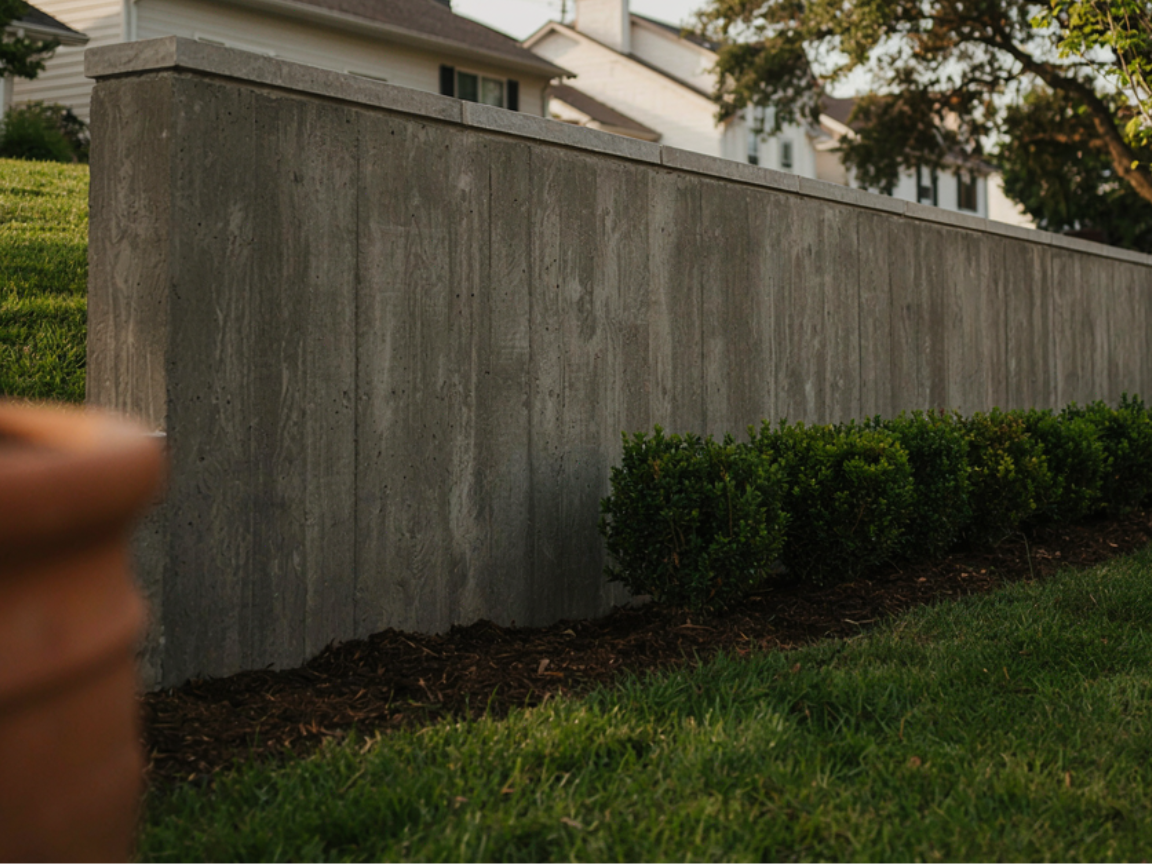
Not every concrete project in the yard needs to hold back three feet of soil. Curbing, sometimes called landscape edging, is a much smaller cousin of the taller structural wall, and it solves a completely different set of problems. A continuous poured border creates a clean, permanent line between mulch beds, grass, gravel paths, and driveways, without the gaps, shifting, and eventual weed invasion that comes with plastic or metal edging over time.
The appeal here is mostly about maintenance, or more accurately, the lack of it. Bermuda grass in particular has a well-earned reputation around here for creeping into flower beds no matter how many times it gets pulled back, and a solid strip of curbing gives it a physical barrier it genuinely cannot cross. Mulch stays where it’s raked instead of migrating onto the lawn after every heavy rain, and the whole bed keeps a tidy, defined edge without constant re-edging every few weeks.
Borders are also one of the more flexible decorative projects available, since they can be poured in a simple broom finish, stamped to match a nearby patio, or colored to complement a home’s exterior. They work well around trees, where roots can make a straight metal edge nearly impossible to install cleanly, and they hold their shape around curves and circles far better than segmented alternatives. For a relatively small investment, this kind of curbing tends to be one of those upgrades homeowners wish they had done years earlier, right after they finally stop finding stray landscaping rocks in the grass every spring.
Walls and Borders for Businesses, Too
Commercial properties around Fulshear use structural walls and borders just as often as homes do, usually for slightly different reasons. Parking lots often sit at a different grade than the surrounding land, which means a wall like this may be doing quiet, essential work along the edge of a property that most customers never consciously notice. Detention pond slopes, required by many municipal drainage regulations for new commercial development, frequently need stabilization where they meet parking areas or walkways, particularly near newer retail development along corridors like FM 1093.
This kind of curbing shows up constantly in commercial landscaping too, defining parking islands, separating drive lanes from pedestrian areas, and protecting landscaped beds from being run over by the occasional driver who takes a corner a little too enthusiastically. These are lower-drama projects than a full structural wall, but they still benefit from the same basic principles: a properly prepared base, correctly placed joints, and a finish that can handle years of Texas sun without cracking or fading.
Serving Fulshear and the Surrounding Area
Contact us today to learn how our professional concrete services can enhance your home or business appearance, functionality, and lasting value.
Ready to Hold the Line?
Our wall and border projects cover Fulshear itself, including newer developments like Cross Creek Ranch, Jordan Ranch, and Tamarron, where graded slopes near ponds and drainage areas are a common feature of the landscape design.
We also work out toward Katy and Cinco Ranch, where similar drainage-driven grading creates plenty of demand for both structural walls and decorative borders.
Toward Richmond and Pecan Grove, near George Ranch Historical Park, we often handle wall repair and replacement on older properties where a previous wall has finally lost its long battle with water and time.
We also serve Rosenberg, Sugar Land, and the wider communities of Simonton and Brookshire, where larger lots frequently call for longer border runs and, on properties near creeks or drainage features, more substantial retaining structures.
If you need a serious structural wall to keep a slope exactly where it belongs, or a simple concrete border to finally win the war against creeping Bermuda grass, Churchill Concrete brings the same careful drainage planning and honest advice to every project, no matter the size.
Call Churchill Concrete today at (281) 201-0262 or request your free on-site consultation online.
We proudly serve Fulshear, Katy, Richmond, Rosenberg, Sugar Land, Simonton, Brookshire, and the surrounding area.
Complete This for Your Free Estimate!
Common Questions from Customers
In the vast majority of cases, the cause is water pressure building up behind the wall because of poor or missing drainage. Without a way to escape, trapped water pushes against the wall constantly, and over time that pressure causes leaning, bulging, or eventual failure.
A structural wall is built to hold back soil under real pressure, often along a slope or a raised bed. A border, sometimes called curbing or edging, is a much smaller feature designed to create a clean line between landscaping elements, and it doesn’t carry the same load-bearing responsibility.