Concrete Contractor in Fulshear, TX: Driveways, Patios, Foundations & Retaining Walls
Custom concrete driveways, patios, walkways, foundations, and flatwork built for Texas weather, Texas properties, and long-lasting performance. Churchill Concrete provides residential and commercial concrete installations throughout Fulshear, Katy, Richmond, Brookshire, and the surrounding areas.
Walkways, Slabs, Sidewalks & Patios
Some things in life should be tough. Your boots. Your truck. Your grandma’s cast iron skillet. And the concrete under your car, your house, and your business.
Welcome to Churchill Concrete. We pour, shape, and finish concrete for homeowners and business owners in Fulshear and the towns nearby. Driveways, patios, foundations, slabs, decorative surfaces, retaining walls, borders…if a job starts as wet gray mud and ends as something you can stand on, we can build it.
Here is a fun fact to start. Fulshear was named for Churchill Fulshear, an early Texas settler. Our company is named Churchill too. We didn’t plan that. But we like to think it was a sign.
Of course, you should not hire a company because of a name. Hire us because of the work. Read on to see what we build, why local soil and weather change the way concrete should be built, how a job goes from the first phone call to the last cleanup, and where we work. There are also some answers to common questions at the bottom. So grab you a glass of sweet tea and keep reading as it is long, but concrete is a big subject.
Why Fulshear Is Growing on Concrete
Fulshear has changed fast. In 2010, about 1,100 people lived here. By 2020, that number grew to about 17,000. That is nearly fifteen times bigger in ten years, and it put the city on lists of the fastest-growing places in the country. Fort Bend County, which surrounds the city, is home to more than 800,000 people.
All of that growth stands on concrete. Every new home needs a slab. Every new neighborhood, like Cross Creek Ranch and Jordan Ranch, needs sidewalks, driveways, and patios. Every new store or office near the Grand Parkway and FM 1093 needs parking, curbs, and (yes, really) a pad for the dumpster. Nobody writes songs about dumpster pads. But try running a restaurant without one.
Growth is good news, but it brings a few problems too. Builders work on tight schedules, so many new homes come with a plain gray patio and a basic driveway poured to a standard instead of to your taste. Then life happens. You want a bigger driveway for the boat. A covered patio for the smoker. A deck by the pool. A shop out back. That’s where a local crew comes in.
We live and work here. We know the roads, including the Katy Freeway, which is up to 6 lanes wide in places and still finds a way to be full at 5 p.m. We know the soil. We know what a July afternoon does to a fresh pour. That local knowledge shows up in every job.
Concrete Facts Worth Knowing
Concrete looks simple, but there is real science in it, and a few facts might surprise you. After water, people use more concrete than any other substance on Earth, which makes it the most widely used man-made material in the world. It also doesn’t “dry” the way most people think. It cures. Water and cement react in a process called hydration, and that reaction keeps making the concrete stronger for weeks. Concrete can even cure underwater, which is a handy trick if your yard floods.
Timing matters too. A new slab can usually handle foot traffic in a day or two and light vehicles after about a week, and it reaches its planned strength at about 28 days. Size is worth knowing as well. One cubic yard of concrete covers about 81 square feet at 4 inches thick, and it weighs around 4,000 pounds, about the same as a small car.
Concrete also handles our sunshine better than many surfaces. On a sunny 95-degree day, dark asphalt can top 140 degrees, while lighter concrete stays noticeably cooler under bare feet. Finally, here’s the truth most crews won’t tell you at the estimate. Nearly all concrete cracks at some point. A good builder doesn’t promise “no cracks.” A good builder plans where the cracks will go and cuts joints so they hide in straight, tidy lines.
A Short History of Concrete from Rome to Fulshear
People have been mixing rock-hard building materials for thousands of years. The ancient Romans made concrete from lime, volcanic ash, and stone, and they used it to build harbors, aqueducts, and the Pantheon. The Pantheon’s dome is almost 1,900 years old and is still the largest mom-reinforced concrete dome in the world. That’s a pretty good track record.
Modern concrete began in the 1820s, when an English bricklayer named Joseph Aspdin patented Portland cement. He picked the name because the hardened material looked like Portland stone, a popular building rock in England. Steel reinforcement came next, and after that came skyscrapers, highways, and dams. When crews built Hoover Dam in the 1930s, they poured well over 3 million cubic yards of concrete. Because curing concrete gives off heat, they ran cooling pipes through the pours. Without those pipes, the dam would have taken more than a century to cool down.
Fulshear has its own story. Churchill Fulshear was an early settler in Stephen F. Austin’s colony, and the town that carries his name grew up from a small farming community. It’s a long way from cotton fields to cul-de-sacs, and concrete is a big part of how the town got here. The same heat and cure science used at Hoover Dam is at work in every driveway we pour, just on a smaller scale and with fewer tourists.
What We Build
We focus on four main services. Each one has its own page with more detail. Here is the quick tour.
Driveway & Patio Installation in Fulshear, TX
Your driveway is the first thing people see. Your patio is where you spend your weekends. Both need to be flat, strong, and good looking.
A good driveway starts under the concrete, not on top of it. We dig out soft soil, compact the ground, and add a firm base so the slab has even support.
Most home driveways should be at least 4 inches thick. If you park a truck, a trailer, or an RV, 5 or 6 inches is the smarter choice.
We add steel reinforcement, like rebar in a grid, to hold the slab together if it does crack. We also cut control joints. A common rule of thumb is one joint every 2 to 3 feet for each inch of thickness, so a 4-inch slab gets a joint about every 8 to 12 feet. Those joints tell the concrete where to crack, so it happens in a neat line and not across your front walk.
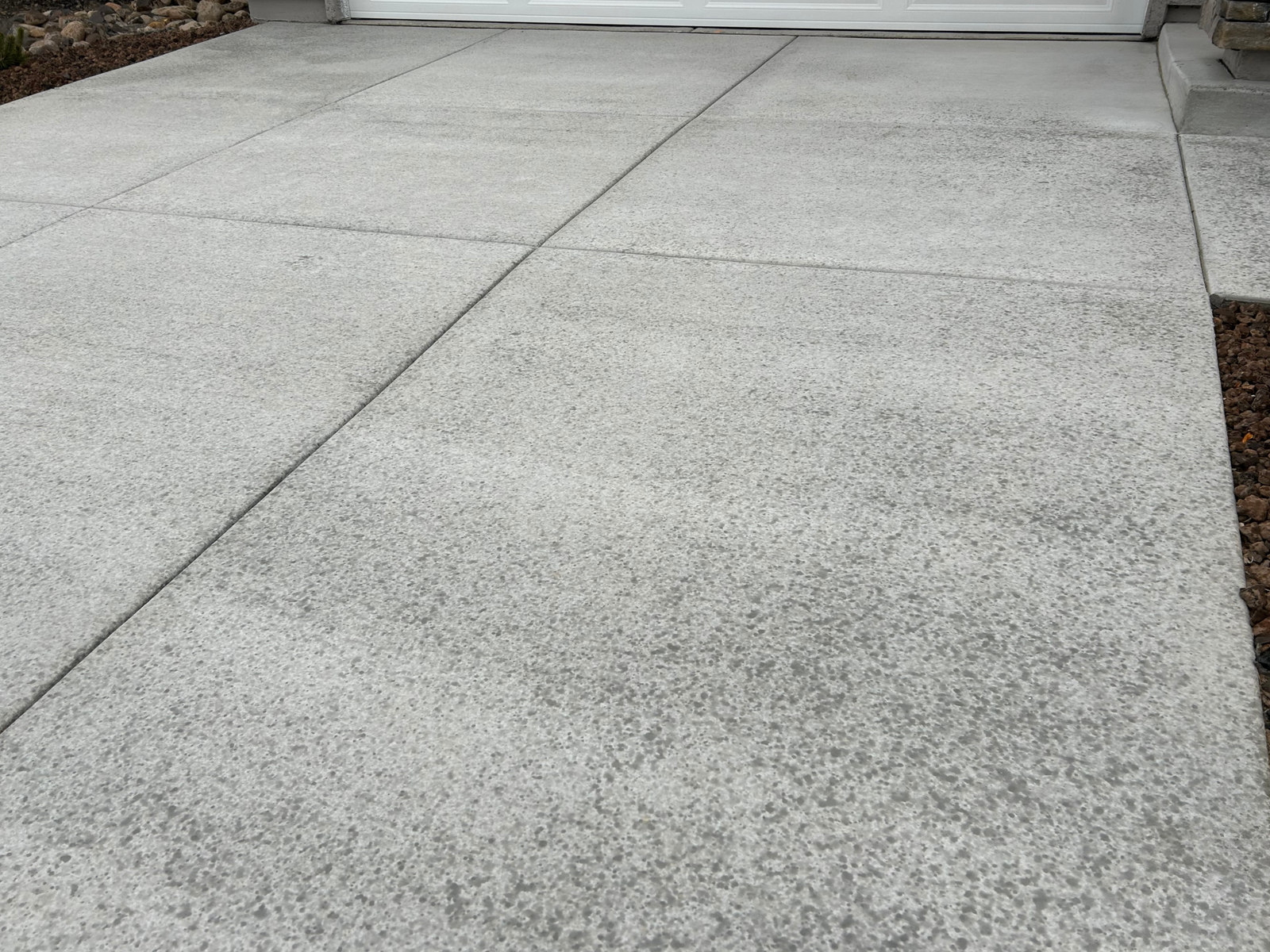
Then there is the slope. A drop of about a quarter inch per foot sends rain away from your garage and house. In this part of Texas, where a summer storm can dump a lot of water in a hurry, that tiny slope matters. We also pay attention to the driveway apron, the section near the street. It often sits in the city’s right-of-way and may have its own rules.
Patios get the same care, with even more choice. Want room for an outdoor kitchen? A fire pit? A spot for the big smoker that costs more than your couch? We plan the size and shape around how you actually live. Popular projects around here include wide back patios, covered seating areas, walkways to the pool, and pool decks. We can also widen a driveway, add a parking pad, pour a slab for an RV, or build a basketball court for the kids (and for the dad who says he “still has it”).
With basic care, a well-built concrete driveway can last 30 to 50 years. That’s a long time to go without thinking about it, and it’s the kind of return that makes a project worth doing once and doing right.
Finish matters on a driveway, too. A light broom finish, made by dragging a stiff broom across the surface, gives tires and shoes good grip when it rains, which is why it’s the most common choice. We also add isolation joints where the driveway meets the garage slab, the street, and the sidewalk, because separate slabs move at different rates and need room to do it. If your current driveway is beyond repair, we can remove it and start fresh, which is often the better choice when the old slab has sunk, split, or been lifted by roots. Color-tinted borders and decorative bands can add a custom look at the edges without changing the whole surface.
Decorative Concrete & Stamped Overlays
Plain gray concrete does the job. But it’s not your only choice, and it’s not always the best looking one.
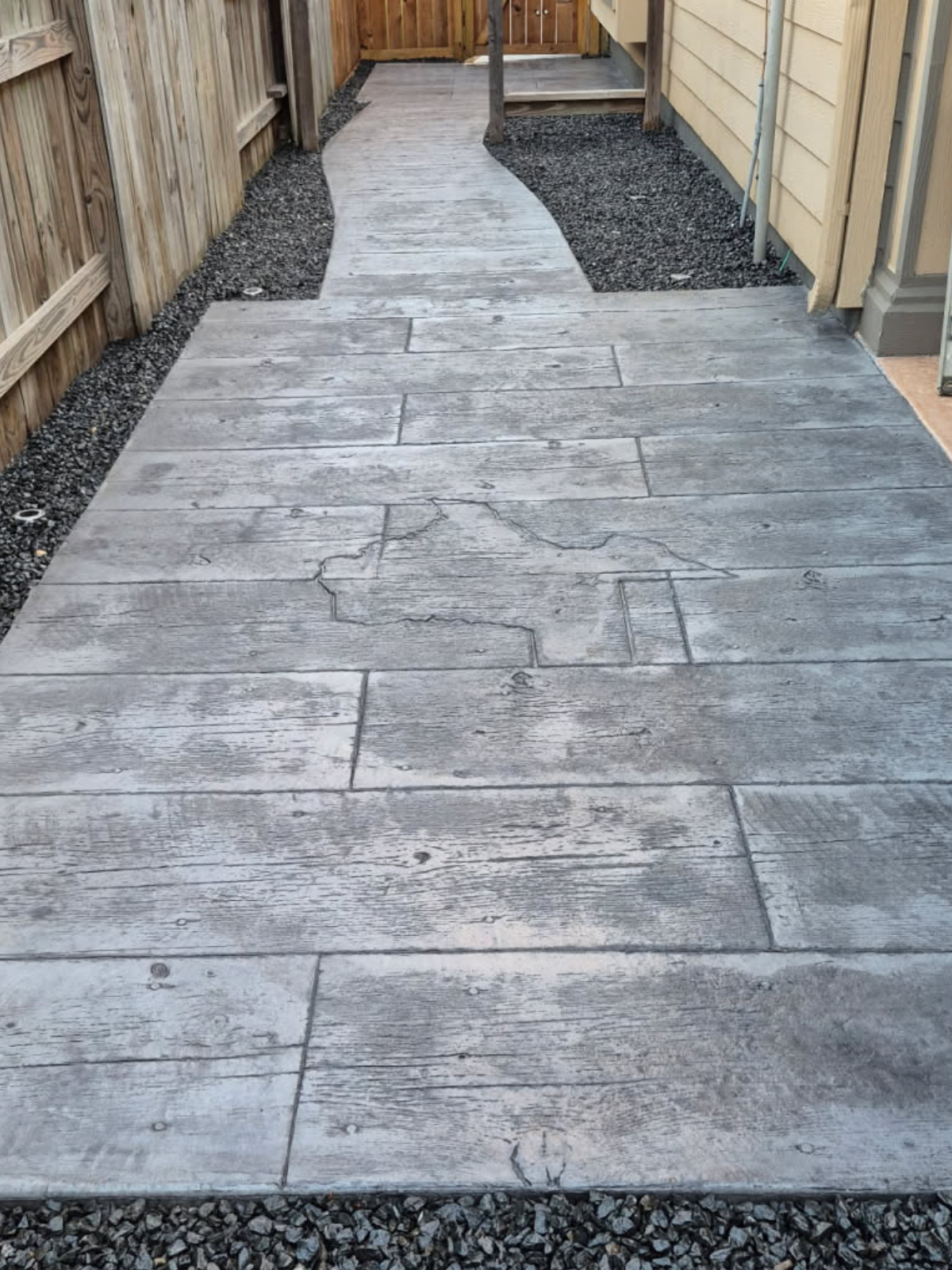
Decorative concrete lets you change the color, the pattern, and the feel of a surface. Stamped patterns are the most popular choice. Tools press designs into the surface while it’s still soft, and the result can look like slate, brick, cobblestone, or wood plank. Color is another option. It can be mixed into the concrete, or stain can be applied after the pour for a rich, layered look. Exposed aggregate washes away the top layer to show the small stones inside, which looks great and gives good grip when wet. Saw-cut designs add clean lines and grids without the cost of a full pattern, and polished finishes turn garage and shop floors into smooth, shiny surfaces that are easy to clean.
Stamped concrete can copy the look of real stone or brick, often for less money and with far less upkeep. Real flagstone needs to be laid one piece at a time, and the gaps between pieces invite weeds. A stamped slab is one solid surface.
Now let’s talk about resurfacing. An overlay is a thin layer of special cement mix, usually between 1/8 and 1/2 inch thick, that bonds to an old slab. It can hide stains, fading, rough spots, and surface wear. It can also be colored or stamped, so a tired, gray patio can turn into something new without the mess and cost of tearing it out and hauling it away.
There is one honest limit. This kind of thin layer fixes the surface, not the structure underneath. If your slab is sinking or heaving, the cause has to be fixed first. We’ll tell you straight if that’s the case, even when it means a smaller job for us.
Pool decks are a special case. Fulshear summers are hot, and a dark deck can be painful on bare feet. Lighter colors and cool-deck coatings keep surfaces more comfortable, and textured finishes reduce slips. Your kids will thank you. So will your feet.
Whatever finish you choose, a good sealer is the final step. It protects the color, blocks stains, and makes cleaning easier. Plan on resealing about every 2 to 3 years.
Color is worth a closer look. Acid stains react with minerals in the concrete to create earthy, marbled tones, and no two surfaces come out exactly alike. Water-based stains offer a wider range of colors, from soft grays to deep blues and bright terracotta. If you’re adding a new section to an existing patio, keep in mind that fresh concrete rarely matches old concrete exactly, because sun, weather, and age change the color over time. A stain or a thin resurfacing layer across the whole area is often the cleanest way to make old and new look like one surface.
Concrete Foundations & Slabs
A foundation is like a good friend. You barely notice it until it moves.
Much of our area sits on clay-rich soil, with sandier pockets closer to the Brazos River. Clay acts like a sponge. It swells when it’s wet and shrinks when it’s dry, and that movement can be measured in inches over a year. A foundation has to stand up to that push and pull without twisting or cracking.
That’s why local slabs are built differently from the ones in, say, a dry desert town. Homes here often use slab on grade foundations with thick edge beams that reach down into the soil, plus a steel grid or post tension cables (steel cables that are pulled tight after the pour to squeeze the slab together). The design comes from an engineer, and we build to those plans. We don’t guess and we don’t “eyeball it,” because the slab under your home is the one thing on your property you really can’t afford to eyeball.
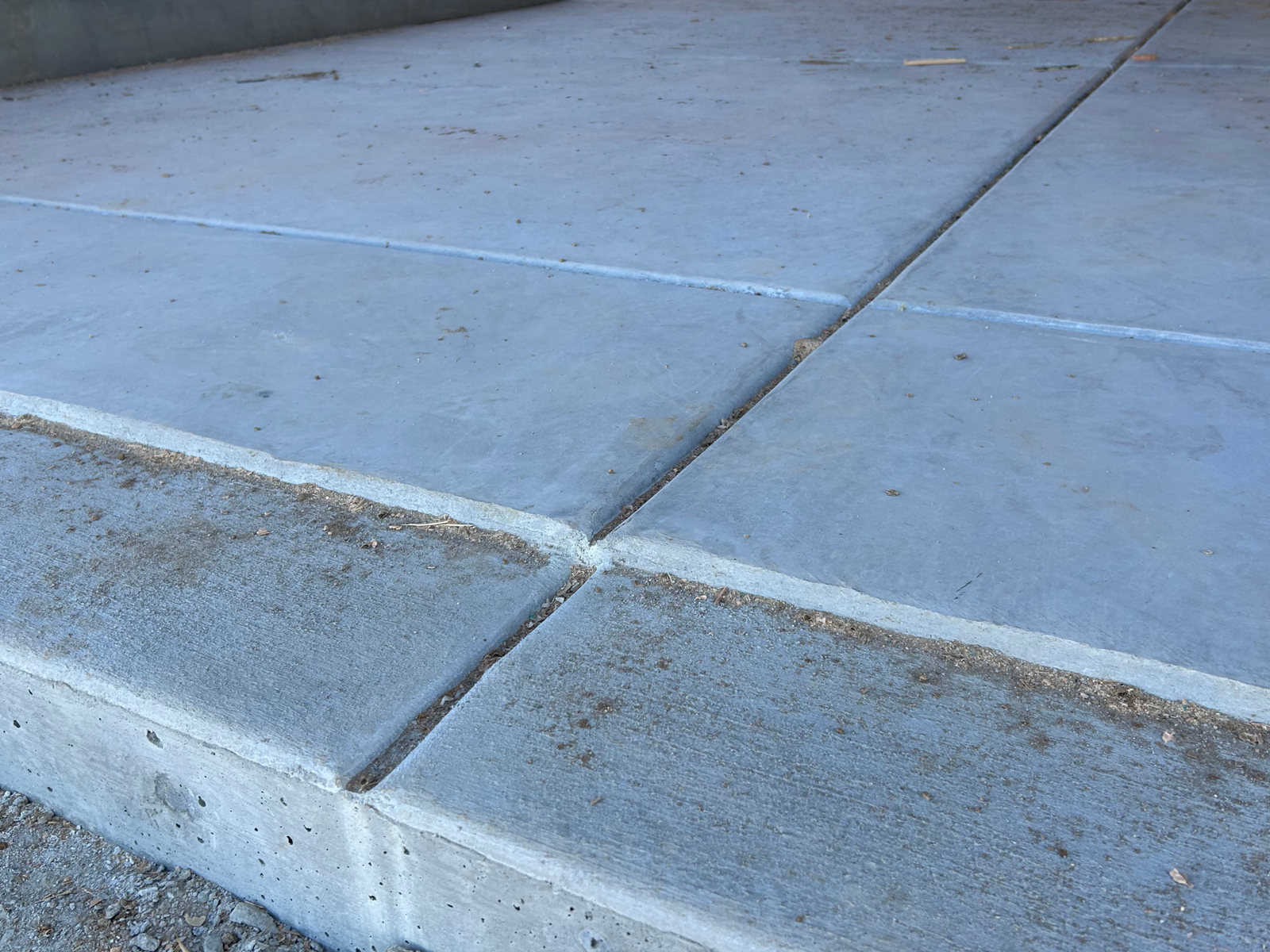
The work before the pour matters most. We prepare and compact the ground, set the forms, place the moisture barrier, check the plumbing lines, and set the steel at the right height. Only then does the truck get the green light.
Our slab work also covers garage floors and detached garages, workshops and barns, sheds and outdoor kitchens, and generator, AC, and pool equipment pads. We build home additions too, tying the new slab into the existing one with steel dowels, and we pour floors for commercial buildings.
Once you have a good foundation, a little care keeps it that way. The biggest enemy is uneven moisture. Water the soil around the house during long dry spells, keep gutters and downspouts pointed away from the slab, and watch for big trees growing too close. If doors start sticking or you see gaps around window frames, call someone to take a look.
Two more details are worth knowing. First, many engineers base a slab design on a soil report, which is a lab study of how the ground on your lot behaves. If your builder or engineer has one, we follow it. Second, most home slabs are poured with concrete rated between 3,000 and 4,000 PSI, and after the pour they need time and moisture to cure. A slab that dries too fast in the sun can end up weak on the surface, so we keep it protected. On post-tension slabs, the cables are tightened only after the concrete has gained enough strength, which usually takes several days.
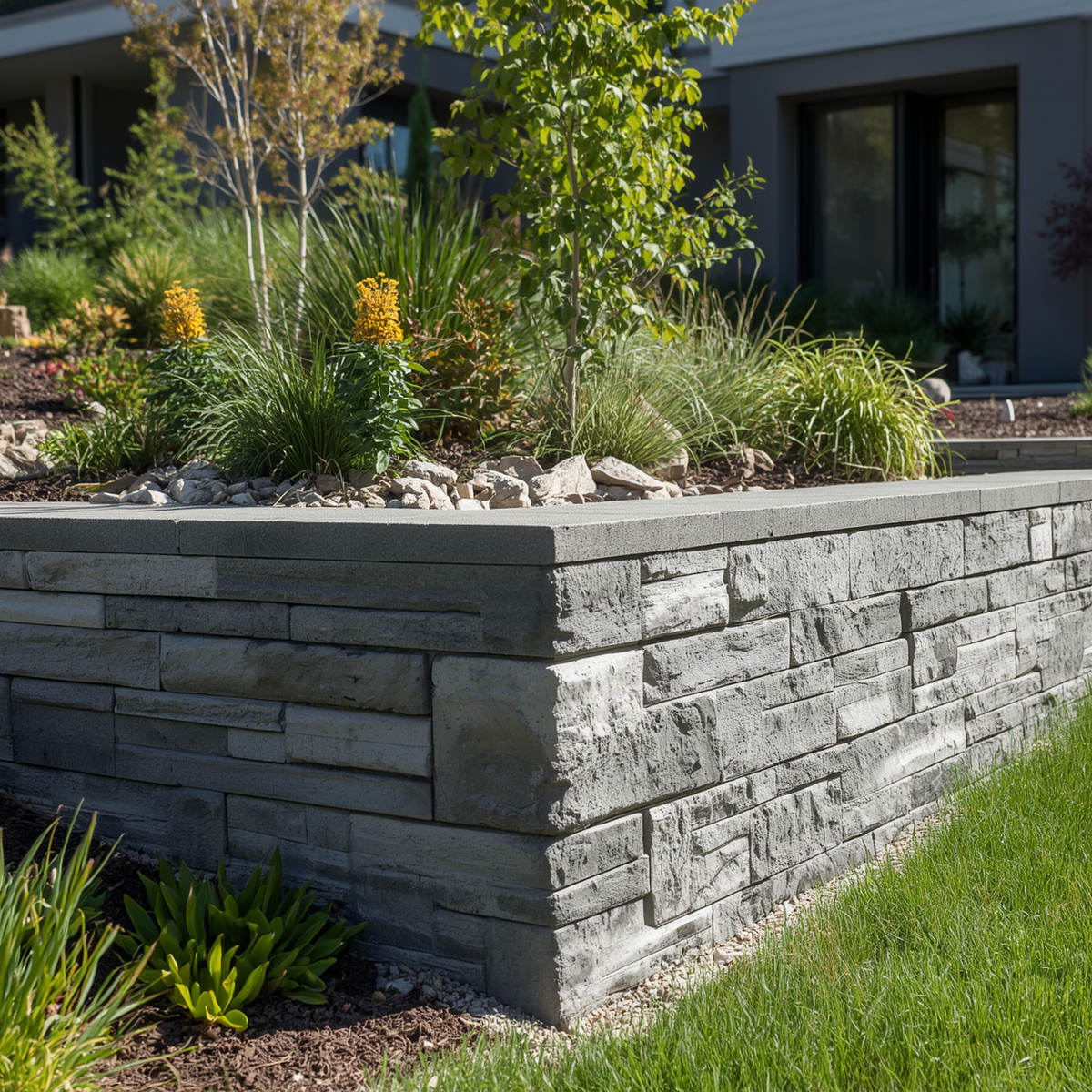
Retaining Walls & Borders
Fulshear is mostly flat, so you might wonder why anyone needs a wall. But you’ll find slopes near creeks, ponds, and drainage ditches. Many yards also have raised patios, terraced beds, or pool areas that need soil held back. A wall is what keeps the yard where you put it.
Soil is heavier than most people think. A cubic foot of dry soil can weigh 100 to 120 pounds, and soaked soil weighs even more. Water is the number one wall killer. It builds pressure behind the wall, and it never gets tired. That’s why a good wall is more than a pile of blocks or a straight pour. We build it with a strong footing, crushed stone behind it, a perforated drain pipe, and weep holes so water has a place to go. Water is patient. We just give it a better plan than pushing your wall over.
We can build with poured concrete for pure strength or with concrete block systems when you want a different look. Height matters too. Walls taller than about four feet generally need an engineered design and may need a permit. We’ll tell you that up front, not after the first delivery.
Borders are the small jobs that make a big difference. A poured concrete border, also called curbing or edging, keeps mulch in and Bermuda grass out. It frames flower beds, lines driveways, circles trees, and cuts down on edging chores. It can be plain, colored, or stamped to match your patio. It’s a small upgrade that most people wish they had done years earlier.
A wall can look as good as it works. Poured walls can be stamped, colored, or covered with a stone veneer, and block walls come in many textures and shades. Safety counts, too. Building codes generally call for a guard rail where the drop from a wall or raised patio is more than 30 inches. Before we dig, we also check property lines and easements, since a wall built on the wrong side of a line can turn into a headache with your neighbors, the city, or both.
Homes, Builders & Businesses: Same Care, Different Scale
Some of our clients are homeowners with one project and a lot of questions. Some are builders with a long list of lots. Some are business owners who need a parking lot fixed before opening day. The approach is the same. Do the prep, use the right mix, and finish clean. What changes is the scale.
For homeowners, we handle the everyday projects: new driveways, patio upgrades, walkways, garage floors, poolside decks, and slabs for outbuildings. We keep the process simple and clear, and we treat your yard like it belongs to us.
For builders and remodelers, we offer dependable flatwork and slabs that fit your schedule. Late crews and open trenches cost you money, so we show up, do the work, and keep you posted.
For commercial clients, concrete has a few extra rules. Parking lots and drive lanes need to be thicker and stronger where trucks travel. A single loaded semi truck can wear a pavement as much as thousands of passenger cars, so delivery lanes and dumpster pads need more than a standard home slab. Commercial mixes are often rated at 4,000 to 5,000 PSI, compared with about 3,000 to 4,000 PSI for many home jobs. Sidewalks and ramps must meet accessibility rules, such as a maximum ramp slope of 1 inch of rise for every 12 inches of run. Businesses also cannot always shut down for a week, so we plan the work in phases and try to keep your customers coming through the door.
Along the shopping areas near the Grand Parkway, FM 1093, and I-10, that kind of planning is what keeps a store open and customers happy. A parking lot with potholes tells people something about a business, and it’s never good.
Built for Fulshear’s Soil, Heat, and Rain
Concrete is the same material everywhere. The problems around it are not. Here is what we plan for in this area.
Rain. We get roughly 50 inches of rain a year, and big storms can bring much more. Hurricane Harvey in 2017 dropped more than 40 inches on parts of the Houston region. Drainage is not optional. We slope slabs away from buildings, protect the ground beneath the concrete from washing out, and think about where the water will go before we pour a single yard.
Heat. Houston-area summers often bring more than 100 days at 90 degrees or higher. Heat and sun make concrete expand, and they fade cheap sealers and colors faster. We place joints to give the slab room to move, and we pick sealers and finishes that can handle years of sunshine.
Clay soil. We already talked about how clay moves. It affects everything from home slabs to walls to the thin slab of a walkway. A good base and good drainage keep the movement from turning into cracks.
Trees. Live oaks and pecan trees are wonderful in a Texas yard. They also have roots that can reach farther out than the branches do, and roots love to lift slabs. We plan around them where we can and talk with you about options where we can’t.
The occasional freeze. Fulshear rarely gets hard freezes, but Winter Storm Uri in February 2021 reminded everyone that it can happen. Properly built concrete takes the odd cold snap in stride. Poorly built concrete does not.
Planning Your Concrete Project: Size, Shape, and Layout
A little planning before the pour saves a lot of regret after it. Start with size, because people almost always wish they had gone a bit bigger. A single-car driveway is usually 10 to 12 feet wide, and a two-car driveway runs about 18 to 24 feet. Adding two or three extra feet beside the drive lets people open car doors without stepping into the flower bed. Walkways should be at least 36 inches wide, and 48 inches is better if two people want to walk side by side. For an RV or boat pad, measure the vehicle, add a few feet on every side, and think about how you will back it in.
Patios follow their own math. A table for four fits comfortably on about 10 by 10 feet, but you also need roughly three feet around it so chairs can slide out. If you dream of a grill, a couple of lounge chairs, and a seating area, a space of 14 by 20 feet or larger is a better starting point. Think about the sun, too. A west-facing patio in July can feel like a frying pan, so plan for shade from a cover, a pergola, or a tree.
Finally, think about what you might add later. It is much cheaper to lay sleeves under a new slab for sprinkler lines, low-voltage lights, and electrical conduit than to cut through it afterward. Talk to us about the future while the ground is still open, and we’ll build in the room.
Five Concrete Myths (and the Truth)
Every crew has heard these at least once. Let’s clear them up.
“Rebar stops cracks.” Not quite. Steel doesn’t prevent cracks. It holds the two sides tight together when a crack forms, so the slab stays level and strong instead of splitting apart.
“Concrete lasts forever.” It lasts a long time, but nothing lasts forever. Water, heat, ground movement, and traffic wear on it year after year. The good news is that a well-built slab can outlast most things placed on top of it, including your car, your grill, and possibly your patience with the neighbors.
“A wetter mix is easier to work, so it must be better.” It’s easier to work, but it makes weaker concrete that cracks and wears faster. Extra water is a favorite shortcut of rushed crews. We don’t take that shortcut.
“Thicker is always better.” Thickness helps, but a thick slab on a bad base is like a fancy bed on a broken frame. The ground under the slab matters just as much as the concrete itself.
“All concrete companies do the same thing.” Two crews can pour the same size slab and produce very different results. The difference is in the mix, the base, the steel, the joints, and the finish. Most of those steps are buried or hidden once the job is done, which is why the person you hire matters so much.
Why Not Do It Yourself?
We respect a good DIY spirit. Some people build their own decks and fix their own trucks. Concrete, though, is the one project where you cannot pause for lunch.
Consider a simple 10-by-10-foot patio at 4 inches thick. That’s about 33 cubic feet of concrete. An 80-pound bag of mix makes only about 0.6 cubic feet, so you would need around 56 bags. That’s roughly 4,500 pounds of bags to lift, open, mix, pour, and level, while the clock is running. Once the concrete starts to set, you can’t undo it.
Then there are the parts nobody tells you about: grading, base prep, forms, joints, the right finishing tools, and the right timing. Miss one and the mistake stays with you for decades. A pro crew has the equipment, the extra hands, and the experience to keep everything moving on schedule. And when your back is sore the next morning, you can be glad you weren’t the one carrying the bags.
Keeping Your Concrete in Good Shape
New concrete is an investment, and a few simple habits help it last. Keep vehicles off a new slab for at least seven days and go easy for the first month. Reseal stamped, stained, and colored surfaces every 2 to 3 years. Wash your concrete gently with mild soap, a broom, and a hose. If you use a pressure washer, keep the wand moving and use a wide spray tip, because too much pressure can scar the surface. Clean spills fast, since oil, rust from fertilizer, and pool chemicals can leave marks if they sit. Fill joints and small cracks with sealant to keep water from getting under the slab, and mind your sprinklers, because water that soaks the edges of a slab all day can wash out the soil underneath.
What Affects the Price of a Concrete Project?
Everyone wants a number right away, and we understand. But two jobs that look the same can be priced very differently. Size and thickness matter most, because more area and thicker slabs mean more material and more labor. Site conditions come next. Slopes, soft soil, tight access, and trees all affect the work. Tearing out and hauling away an old slab takes time, equipment, and disposal fees, and reinforcement like rebar, mesh, or cables costs more than a bare slab (and it’s worth it). Finish plays a big part as well. Broom finishes cost the least, while stamped patterns, colors, and resurfacing take more time and skill. Extras like steps, borders, drains, and lighting conduit add to the total, and some jobs need permits or neighborhood approvals that can affect timing and cost.
The cheapest bid is not always the best deal. If a quote is far below the others, ask what was left out. Thin slabs, weak bases, and skipped steel do not show up on day one. They show up in year three.
How to Choose a Concrete Contractor in the Fulshear Area
Picking a contractor is a big decision, so here is how to do it well. Look at the work. Ask for photos of finished jobs and a few local references, and read the reviews on the company’s Google Business Profile. Look for detail in the written quote. It should state the thickness, the strength of the mix, the type of steel, the base preparation, and the plan for joints and curing.
Watch out for a few classic red flags. Beware of anyone who shows up at your door saying they have “leftover concrete from a job down the street,” since that story has fooled homeowners for decades. Be careful with large deposits before any work begins, and with anyone who will only take cash. A trustworthy company will answer your questions, put things in writing, and be happy to explain what they’re doing. That’s the standard we hold ourselves to.
Why Churchill Concrete?
There’s a lot of choices when you need concrete work, so here’s what we promise. We do the prep right, because most concrete problems begin below the surface. We explain things so you understand your quote and your options before you move forward. We tell you the truth. If you don’t need a full replacement, we’ll say so, and if a wall needs an engineer, we’ll say that too. We show up and communicate, so you know when we’re coming and what’s happening at each step. And we clean up, so your yard looks better when we leave than when we arrived.
Ready to Start Your Concrete Project?
If you want a driveway that turns heads, a patio built for weekend cookouts, a slab that will not move, or a wall that holds strong through every storm, we’re ready to help. Tell us about your project, and we’ll visit, measure, and give you a clear quote.
Call Churchill Concrete today at (281) 201-0262 or request your free quote online.
Serving Fulshear, Katy, Richmond, Rosenberg, Sugar Land, Simonton, Brookshire, and the surrounding area.
Bring the questions. Bring the wish list. We’ll bring the trucks (and maybe a sense of humor).
Feedback from Our Customers
We hired this company for a driveway extension and the entire process was straightforward and professional. They explained the options clearly, prepared the site properly, and delivered a smooth, well-finished result that matches our existing driveway beautifully.
Jim R. ResidenceGreat work and fair pricing! Needed a small concrete walkway by the side of our house and Churchill Concrete got it done fast. It looks clean and is exactly how we wanted it.
Ashley T. ResidenceThis concrete place completed repairs and put in a new sidewalk section at our commercial property. Their team coordinated efficiently around our operating hours, maintained a safe work area, and completed the project to a high standard. We were very pleased with their communication and work ethic.
Daniel P. BusinessOur business needed a dependable contractor for a large concrete project. This company stayed organized, met the agreed-upon schedule, and provided excellent work with a professional finish. We would use them again for future property improvements.
Bob L. BusinessProudly Serving Fulshear & All the Surrounding Areas
Unsure if we can complete a job in your area? Call or e-mail us and if we can get there, we’ll most likely take on your project. If you’ve been searching for “concrete installation near me” or “concrete company in Fulshear, TX” and you landed here, you’re in the right spot.
Churchill Concrete
How We Work: From Initial Call to Final Cleanup
Great concrete work comes from a good process, so here’s what you can expect. It starts with a free on-site visit. We walk your property, measure the area, look at drainage, check how a truck can get in, and listen to what you want.
No pressure, and no jargon.
Next, you get a clear quote that lists the size, thickness, steel, finish, removal of old concrete, and timing, so there are no surprises.
Then comes the prep work, which is the least exciting part but the most important. We have utilities marked, remove old concrete if needed, dig, grade, compact the base, set the forms, and place the steel.
Once that’s done, we pour and finish. Concrete has a clock. It must generally be placed within about 90 minutes of mixing, so the crew is ready before the truck arrives. We level, float, and finish the surface, and we cut the joints at the right time.
After the pour, we protect the surface while it cures and tell you when to keep off it. Fresh concrete is a magnet for paw prints. We love dogs, just not that much.
Last, we pull the forms, haul away leftovers, and walk the job with you before we call it done.
Complete This for Your Free Estimate!
Common Questions from Customers
Fall and spring are the easiest seasons, with mild temperatures and steady curing. But we pour ALL year long. In summer, we start early in the day, keep the mix cool, and protect the surface from fast moisture loss, because fast drying leads to weak surfaces and cracks. In winter, we watch the forecast for the rare freeze. The best time is really the time we can protect the pour.
Sometimes. If the slab is solid and level and the problem is on the surface, like stains, wear, or fading, resurfacing can work well. If the slab is sinking, tilting, or badly broken up, resurfacing only hides the trouble for a while. We’ll look at it and give you an honest answer, since replacing the wrong thing wastes your money.
Where We Work: Fulshear and Nearby Towns
Our home base is Fulshear, but we work in a wide circle around it, generally within about 25 miles. Right in town, that includes Weston Lakes, Cross Creek Ranch, Jordan Ranch, and Tamarron. This is our own backyard, with lots of newer homes and lots of people ready to upgrade a builder-grade patio.
About 11 miles east are Katy and Cinco Ranch. Between Katy Mills and Typhoon Texas Waterpark, there are plenty of homes and businesses that need driveways, poolside patios, and parking areas. If your patio has to compete with a water park, make it a good one. Southeast of town you will find Richmond and Pecan Grove, home to George Ranch Historical Park and a mix of older and newer neighborhoods. Older lots often mean bigger trees, older slabs, and more repair and resurfacing work.
Rosenberg, about 17 miles away near the Fort Bend County Fairgrounds, keeps us busy with both residential jobs and commercial lots. Sugar Land, around 22 miles out and close to Sugar Land Town Square, brings a lot of decorative work, from stamped patterns to detailed pool surrounds. Out toward Simonton, Brookshire, Guy, and Pattison, bigger lots mean bigger jobs, like long driveways, shop slabs, barn floors, and RV pads. Not sure if you fall inside our area? Just call. If we can get a truck to you, we probably will.
Churchill Concrete did an amazing job on our new patio. The workers were friendly, showed up on time and kept everything clean. Our backyard looks so much better now and I would gladly recommend them to anyone in Fulshear.
Maria G. Residence