
Decorative Concrete & Overlays in Fulshear, TX
We design and install custom concrete driveways and patios for residential and commercial properties throughout Fulshear, TX and the surrounding area, creating strong outdoor spaces that are as functional as they are attractive.
Plain gray concrete has never hurt anybody. It holds up a car, it holds up a patio table, and it does its job without complaint. But “does its job” and “looks like something you’re proud of” are two different things, and a lot of homeowners around Fulshear are ready for the second one. That’s where decorative concrete comes in, along with its quieter cousin, the overlay, which can take a tired old slab and turn it into something worth showing off.
Churchill Concrete designs and installs custom stamped, stained, and resurfaced concrete for homes and businesses across Fulshear and nearby communities, including Katy, Richmond, Rosenberg, Sugar Land, Simonton, and Brookshire. This page covers what these finishes actually are, how resurfacing works, and why the choices you make here in Fort Bend County are a little different than they would be somewhere with milder weather and softer soil.
What Counts as Decorative Concrete, Exactly?
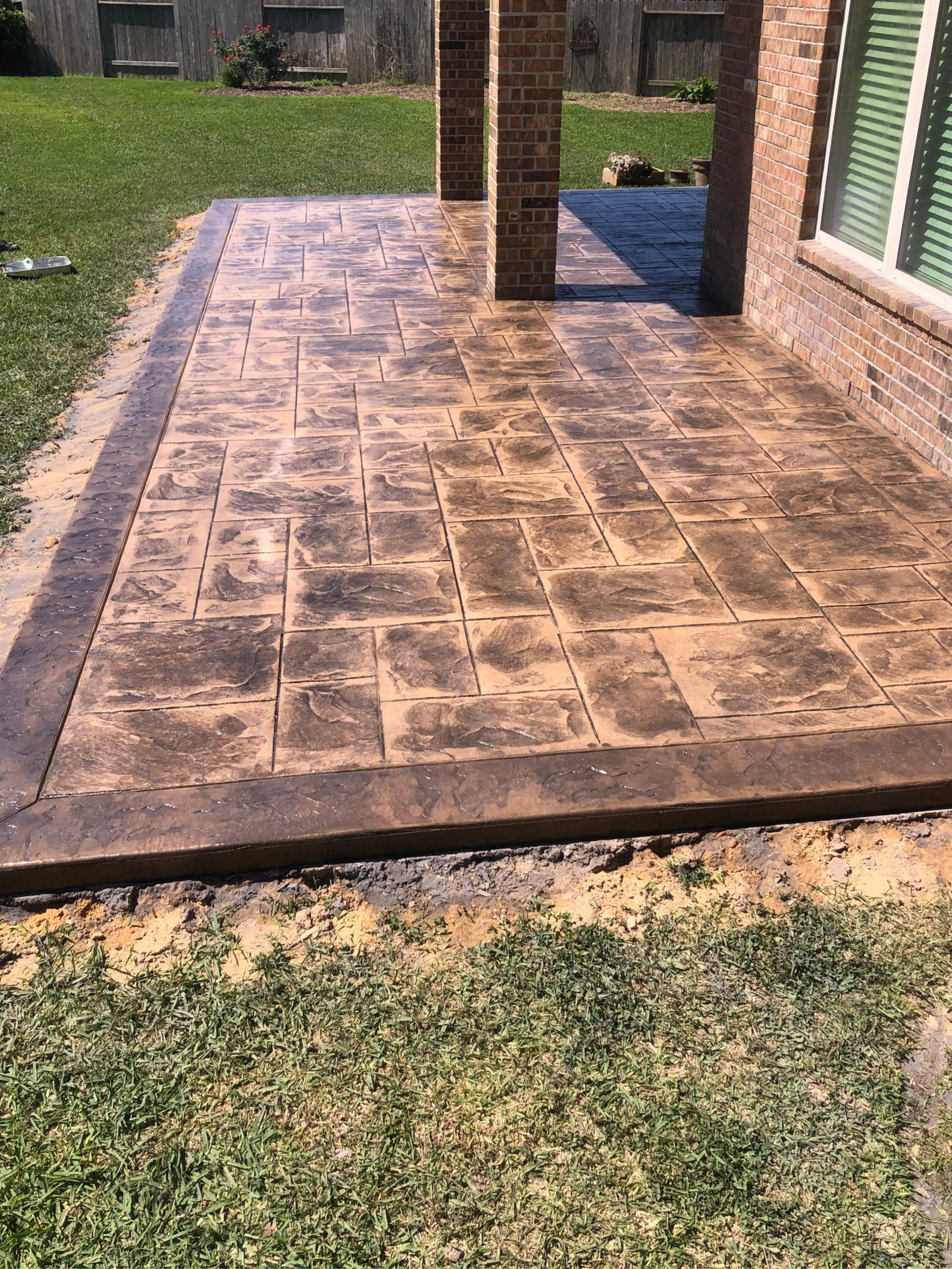
This kind of custom concrete work is a broad category, and it helps to think of it less as one product and more as a toolbox. Stamped concrete is the most recognizable tool in that box. While the concrete is still soft, textured mats or tools are pressed into the surface to create a pattern, and the finished slab can convincingly mimic slate, flagstone, brick, cobblestone, or even wood planks. It’s a bit like a very heavy, very permanent rubber stamp, except instead of ink, you get a driveway that looks like it came from a European courtyard.
Color is the second major tool, and it splits into two approaches. Integral color gets mixed into the concrete before it’s poured, so the color runs all the way through the slab rather than sitting on top of it. Stain, on the other hand, gets applied after the concrete has cured, and it reacts with the surface rather than coating it, which is why stained concrete often has that mottled, natural, almost stone-like variation instead of a flat, uniform tone. Acid stains create earthy, unpredictable patterns, since they are reacting chemically with minerals already in the concrete, and no two acid stained surfaces ever come out looking exactly alike.
Exposed aggregate is another option worth knowing about. During installation, the top layer of cement paste gets washed or brushed away while the concrete is still green, revealing the small stones mixed into the concrete underneath. The result has real texture and grip, which makes it a popular choice for pool decks and walkways where a little extra traction matters. Saw-cut designs offer a more understated look, using clean geometric lines and grid patterns cut into the surface after curing, without the added cost of full stamping. And polished concrete, which is common in garages, shops, and some commercial spaces, uses a series of progressively finer grinding steps to bring out a smooth, glossy shine that is remarkably easy to clean.
Resurfacing Old Concrete: A Facelift for Tired Slabs
Now for the part that surprises a lot of homeowners. If your existing patio, walkway, or driveway is structurally sound but looks worn, stained, faded, or just plain dated, you may not need to replace it at all. An overlay is a thin layer of specially formulated cement material, generally somewhere between one-eighth of an inch and half an inch thick, that gets bonded directly onto your existing concrete surface. Once cured, this thin resurfacing layer can be stamped, colored, textured, or stained just like a brand-new pour, which means an old, blah slab can come out the other side looking like an entirely different material.
The appeal here is fairly obvious once you do the math. Removing an old slab, hauling it away, and pouring a brand-new one takes real time, real equipment, and real disposal fees. Resurfacing skips almost all of that, since the new layer builds on top of what is already there instead of tearing it out. For a lot of patios and walkways around older Fulshear-area neighborhoods, this approach is the difference between a weekend upgrade and a multi-day demolition project.
Honesty matters here, though, and we would rather lose a bigger sale than sell you the wrong fix. This kind of resurfacing improves the surface, not the structure underneath it. If your existing slab is cracked all the way through, sinking unevenly, or heaving from tree roots or shifting soil, that new layer will eventually crack right along with it, because it’s bonded to a problem instead of covering one up. In those cases, we’ll tell you plainly that replacement is the better long-term investment, even though it’s the more expensive answer in the short term.
Why Pool Decks Deserve Extra Thought
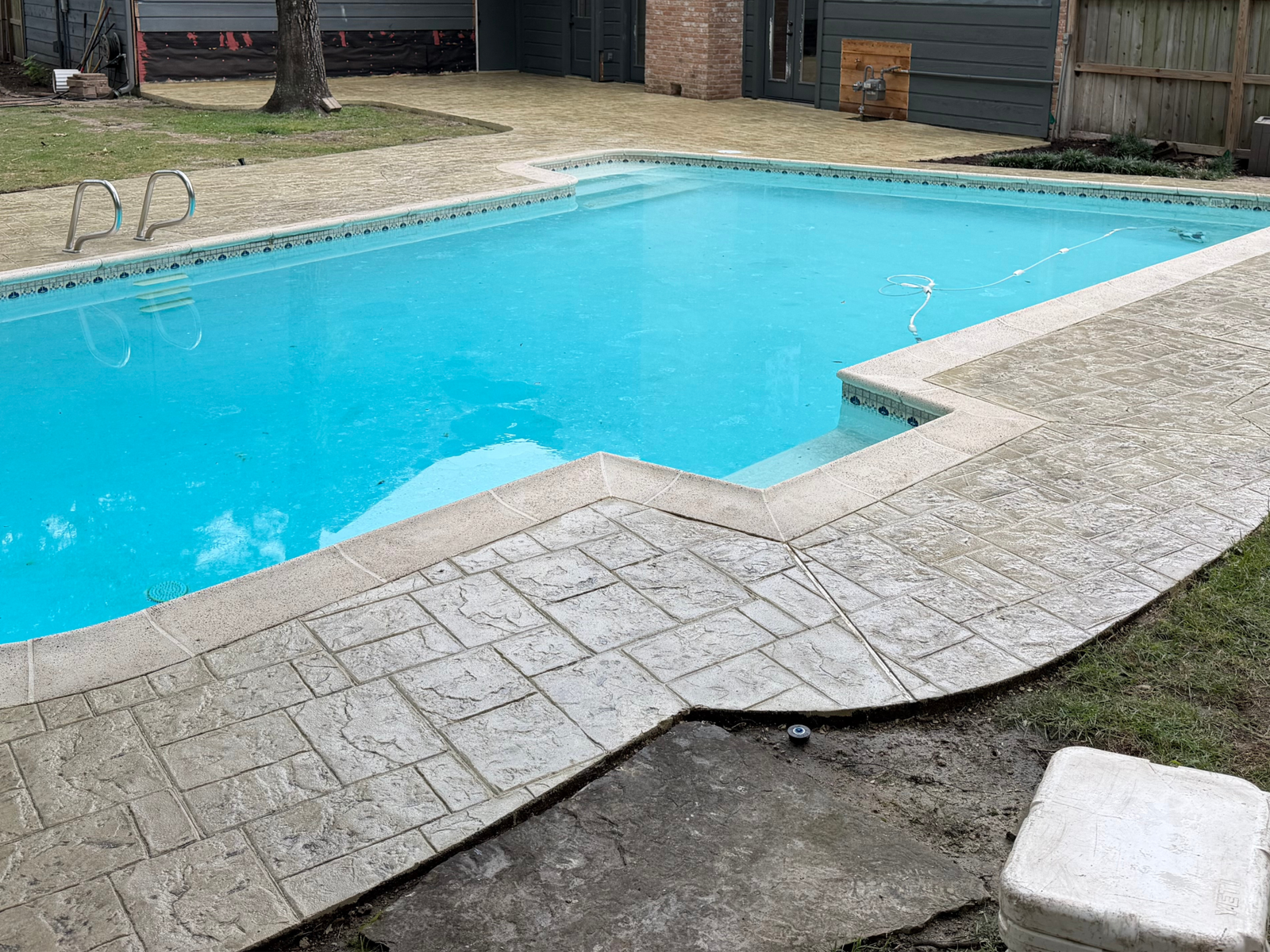
If there is one place in this climate where these finishes earn their keep, it’s the pool deck.
A smooth, dark-colored slab sitting in direct Texas sun can become genuinely painful to walk across barefoot, and anyone who has hopped across one on a July afternoon knows the particular dance that follows.
Lighter colors reflect more heat than dark ones, and textured finishes, whether from stamping, exposed aggregate, or a broom-finished resurfacing layer, both look better and stay noticeably cooler and safer underfoot.
Slip resistance matters just as much as temperature around a pool. A glossy, high-shine sealer might look sharp in photos, but it can turn dangerous the moment it gets wet.
We generally recommend a matte or slip-resistant sealer for any surface that regularly gets splashed, walked on with wet feet, or exposed to sprinkler overspray. Cool-deck style coatings, which combine light color with a fine texture, remain one of the most popular choices for pool surrounds in this area for exactly that reason: they solve the heat problem and the slip problem at the same time.
Sun, Rain & Clay: Why Local Conditions Shape the Right Finish
These custom surfaces have to survive the exact same weather as plain concrete, and around Fulshear that means real heat, real rain, and soil that moves more than most people realize.
Summers here regularly deliver more than 100 days at 90 degrees or hotter, and that sustained sun exposure fades cheap sealers and low-quality colorants far faster than most homeowners expect. A quality sealer, reapplied roughly every two to three years, protects both the color and the texture of a decorative surface and is honestly the single easiest thing a homeowner can do to keep a stamped or stained patio looking sharp for the long haul.
Rain plays its own role, too. This part of Texas sees somewhere around 45 to 50 inches of rainfall a year, often arriving in short, heavy bursts rather than gentle, steady showers. A properly sealed decorative surface sheds water rather than absorbing it, which matters for color longevity and also helps prevent the kind of freeze-thaw damage that can occur, even in a place that rarely freezes, because water trapped inside porous concrete can still cause problems when temperatures do dip.
Then there is the soil, which is the quiet variable behind almost every concrete problem in this region. Much of the ground around Fulshear contains a meaningful amount of clay, and clay swells when it absorbs water and shrinks as it dries out, sometimes shifting by a noticeable margin over the course of a single year. A stamped or stained surface doesn’t get a pass on this just because it looks nice. Joint placement, proper base compaction, and adequate slab thickness all still apply, whether the surface on top is plain gray or a hand-stained masterpiece that took three color passes to get right.
A Brief, Slightly Nerdy History of Stamped and Stained Finishes
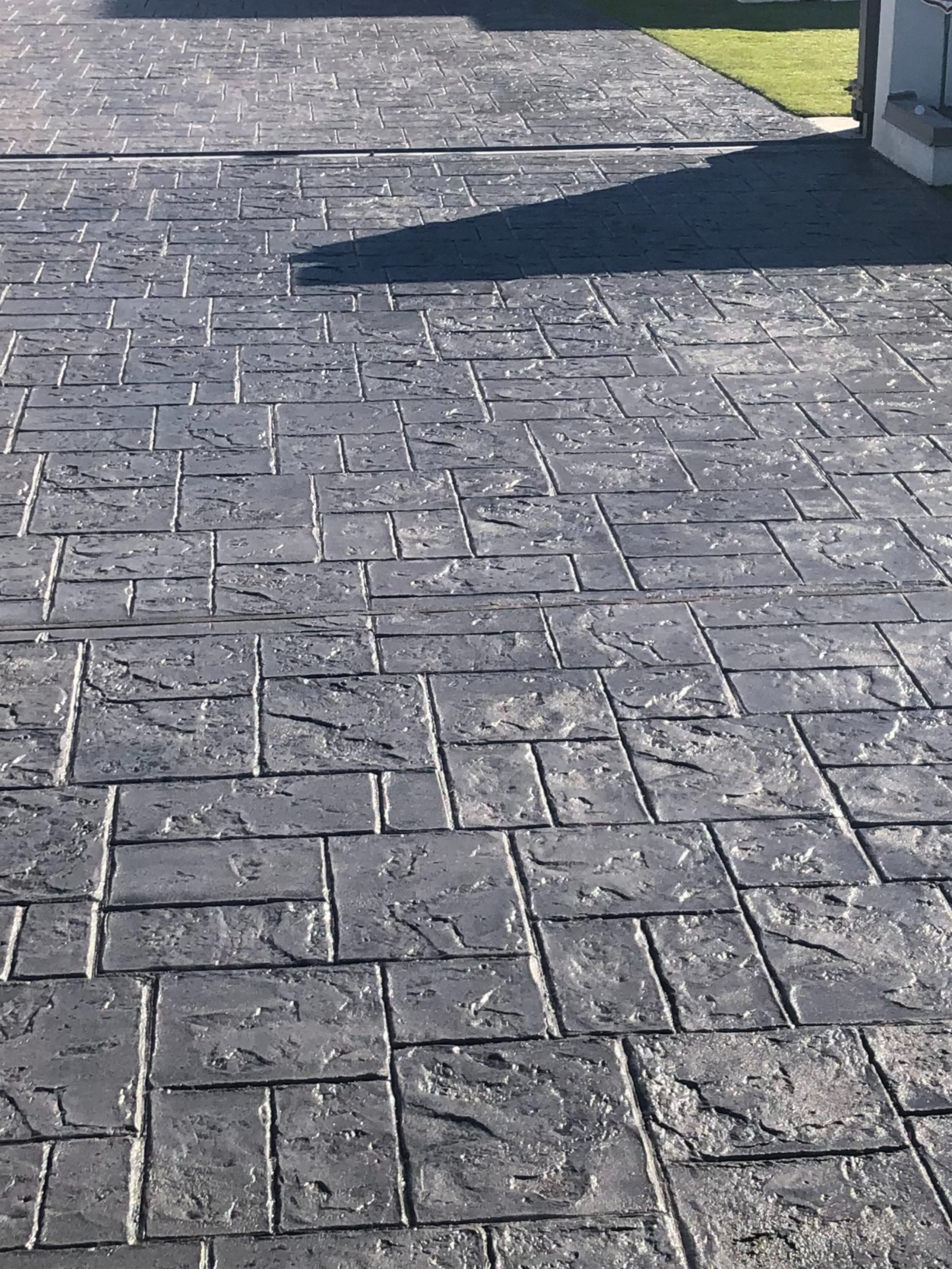
Stamped and colored concrete might feel like a modern trend, but the underlying idea is older than most people assume. Techniques for coloring and texturing concrete surfaces trace back to the early twentieth century, when builders experimented with ways to make an increasingly common material look less industrial and more intentional. The stamping tools and imprinting systems used today, capable of replicating everything from Texas limestone to reclaimed barn wood, really came into their own in the 1970s and have improved steadily ever since.
There’s a fitting parallel closer to home, too. Fulshear itself grew from a small farming settlement founded in the early days of Stephen F. Austin’s colony into one of the fastest-growing cities in the entire country over the last decade, according to recent Census figures. In a similar way, this kind of finished concrete grew from a purely practical building material into something homeowners now choose specifically for how it looks, not just what it holds up. Plain slabs still have their place, the same way plain fields once did, but plenty of people around here would rather have something with a little more character.
Where We Install These Custom Concrete Finishes
Our custom concrete and resurfacing work stretches across Fulshear and its newer neighborhoods, including Cross Creek Ranch, Jordan Ranch, and Tamarron, where many homes still have the plain, builder-standard patios that came with the house. We also take on projects out toward Katy and Cinco Ranch, where updated pool decks and stamped patios are a common request near the shopping and entertainment around Katy Mills.
Ready to Upgrade Your Concrete?
Closer to Richmond and Pecan Grove, near George Ranch Historical Park, this kind of resurfacing is especially popular, since many of those homes have older concrete that is structurally solid but visually past its prime.
We also serve Rosenberg, Sugar Land, and the wider communities of Simonton and Brookshire, where larger properties often mean bigger decorative projects, from expansive stamped courtyards to entire pool areas finished in a single coordinated color and texture.
Gray concrete gets the job done, but it doesn’t have to be the final word on your patio, walkway, or pool deck.
If you want the look of natural stone without the natural stone price tag, a fresh coat of personality on a faded old slab, or a pool deck that won’t turn your evening swim into a barefoot obstacle course, Churchill Concrete can design and install the right decorative solution for your property.
Call Churchill Concrete today at (281) 201-0262 or request your free design consultation online.
We proudly serve Fulshear, Katy, Richmond, Rosenberg, Sugar Land, Simonton, Brookshire, and the surrounding area.
Complete This for Your Free Estimate!
Common Questions from Customers
Stamped concrete is a texture technique applied to a fresh, newly poured slab while it is still soft. Resurfacing uses a separate material bonded on top of existing concrete, which can then be stamped, colored, or textured. In other words, stamping is a finishing step, while resurfacing is a separate product that can also be stamped afterward.
Stamped concrete usually costs less than natural stone or paver installations of a similar size, while offering a comparable look. It also requires far less long-term maintenance, since pavers can shift, sink, or grow weeds between the joints, especially in areas with clay-heavy soil like ours.