
Driveway & Patio Installation in Fulshear, TX
Our concrete driveway and patio installation services in Fulshear, TX are built to give your property a beautiful, functional surface that lasts for years to come. We design and install custom concrete driveways and patios that add great appearance, outdoor comfort, and lasting value to your home.
A driveway and a patio do very different jobs, and it shows the moment you step outside. One holds up a two-ton truck every single day. The other holds up a lawn chair, a cooler, and maybe a napping dog on a Saturday afternoon. Both are concrete. Both have to survive a Fulshear summer. And both deserve to be built by someone who understands the difference.
Churchill Concrete installs driveways and patios for homes and businesses throughout Fulshear and the surrounding towns, including Katy, Richmond, Rosenberg, Sugar Land, Simonton, and Brookshire. This page focuses on exactly two things: the slab your car sits on, and the slab your life happens on. Grab a cold drink, find some shade, and let’s get into it.
Why Driveways Take More Punishment Than People Think
A driveway looks like it just sits there, but it works harder than almost anything else on your property. A single passenger car weighs somewhere between 3,000 and 4,500 pounds, and most families roll that weight across the same strip of concrete several times a day, every day, for years. Add a full-size pickup, and you are often pushing past 6,000 pounds before anybody even loads the truck bed with mulch or lumber.
That kind of repeated weight is why driveway thickness matters more than most homeowners expect. A standard home driveway should be at least 4 inches thick, and if you regularly park a truck, boat, or RV, stepping up to 5 or 6 inches is worth the extra cost. Thickness alone will not save a driveway, though. The ground underneath has to be compacted and stable, because a slab is only as strong as what is holding it up. We remove soft or loose soil, compact a solid base, and only then bring in the concrete truck.
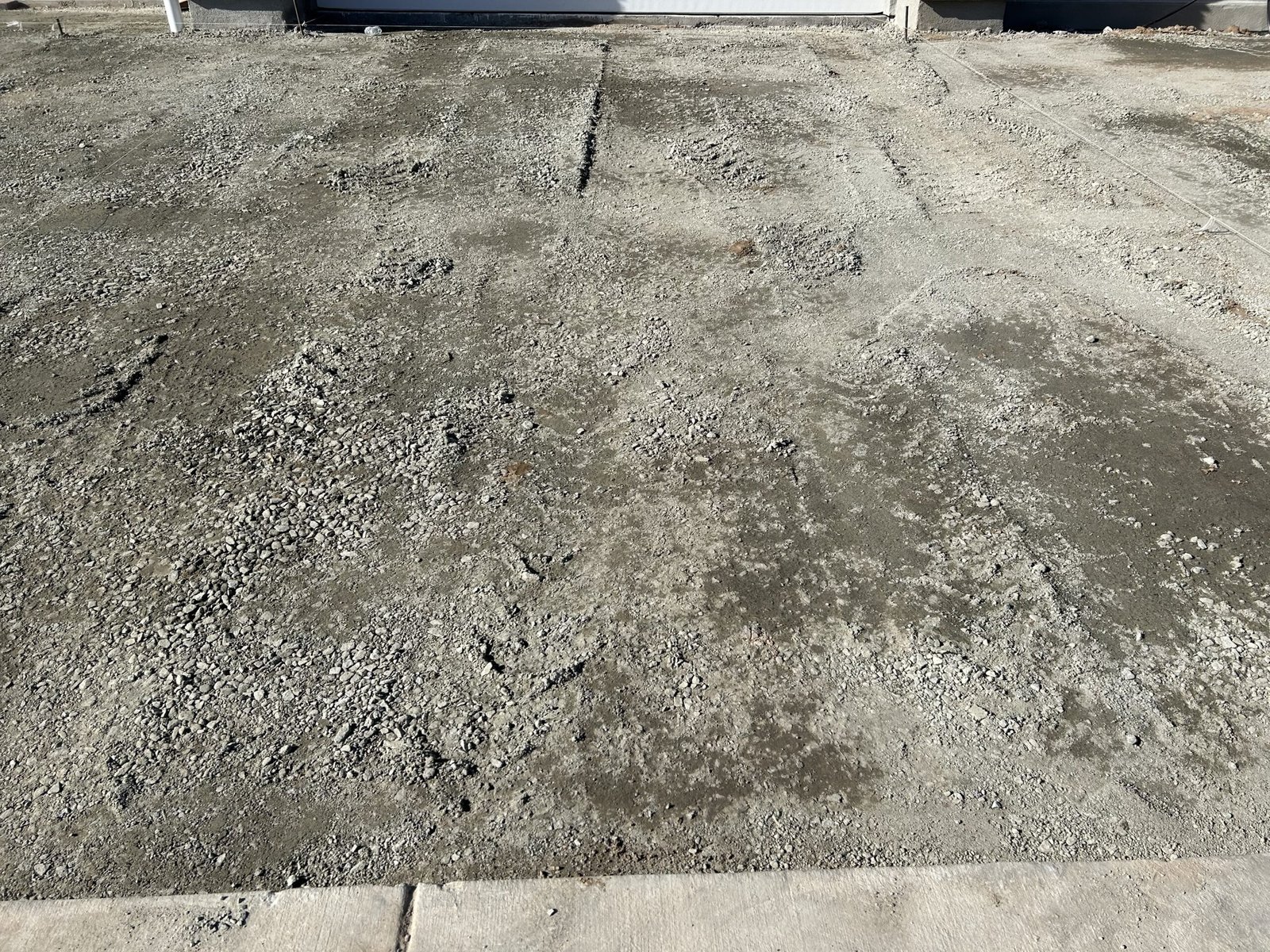
Slope is the other detail that separates a driveway that lasts thirty years from one that turns into a problem after two rainy seasons. A slope of about a quarter inch per foot moves water away from the garage and toward the street, instead of letting it pool near your foundation. Around Fulshear, where storms can drop several inches of rain in an afternoon, that small slope is doing quiet, constant work every time the sky opens up.
We also plan for how the driveway meets everything around it. The apron near the street often falls inside the city’s right-of-way, so it may follow different rules than the rest of the driveway. We separate the driveway from the garage slab and the front walk with isolation joints, because each section of concrete expands, contracts, and settles a little differently, and forcing them to move together is asking for a crack. And we cut control joints at set intervals, generally every 8 to 12 feet on a 4-inch driveway, so that when concrete eventually does crack (and nearly all concrete does, eventually) it cracks along a straight, planned line instead of a jagged one across the middle of your parking spot.
Finish matters too, and not just for looks. A broom finish, made by dragging a stiff-bristled broom across the surface while it’s still workable, creates thousands of tiny grooves that give tires and shoes traction, which matters a great deal on a wet Texas morning. Some homeowners choose to dress up a plain driveway with a stamped or colored border along the edges, which adds character without the cost of stamping the whole surface. If your current driveway has sunk, split into large slabs, or developed a slope that sends water toward your garage instead of away from it, replacement is usually smarter than patching, and we’ll tell you honestly which situation you’re in.
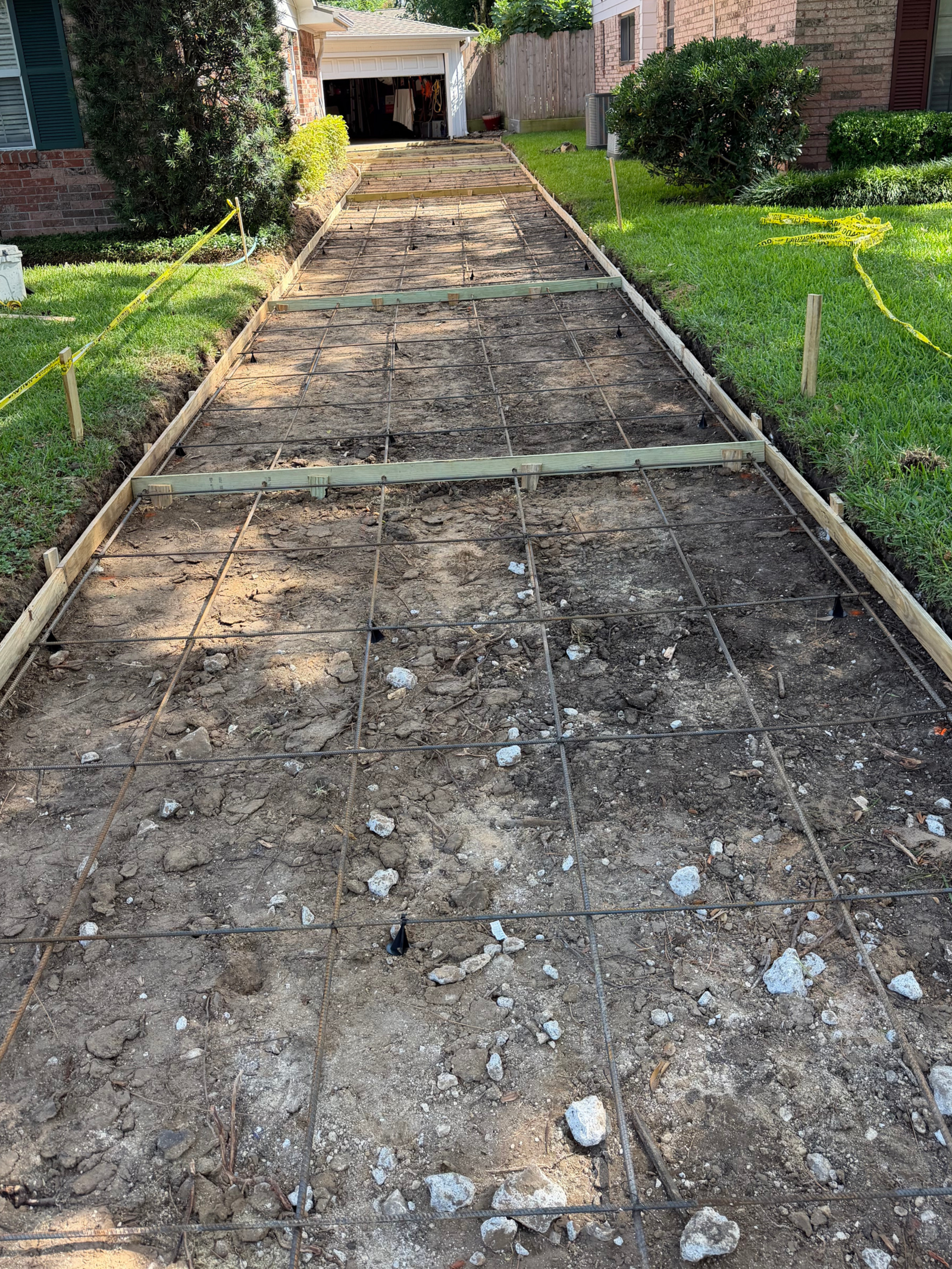
2 Jobs, 2 Different Concrete Mixes
Here is something most homeowners never hear from a contractor: a driveway and a patio often shouldn’t use the exact same concrete mix, even though both are “just concrete.”
A driveway needs to resist the constant, heavy, rolling weight of vehicles, so it typically uses a higher-strength mix, often in the 3,500 to 4,000 PSI range, with steel reinforcement to hold everything together if the slab does crack under that load.
A patio carries foot traffic, patio furniture, and the occasional dropped burger, so it can often use a slightly different mix design, with more of the budget going toward finish quality, color, and texture instead of raw load capacity.
This is also where reinforcement choices split. Driveways commonly use a grid of rebar or welded wire mesh set at the right height within the slab, since that steel does the real work of holding a cracked driveway together under vehicle weight.
Patios still benefit from reinforcement, but the priority often shifts toward proper joint spacing and a well-compacted base rather than maximum steel, since the loads are lighter and the goals lean more toward appearance and comfort.
Curing time is one thing both surfaces share.
Concrete reaches enough strength for careful foot traffic within a day or two, but it needs about a week before light vehicles should drive on it, and it keeps gaining strength for close to a month after the pour. Driving on a driveway too soon, even gently, can leave tire marks or weaken the surface before it has had the chance to fully cure.
A Concrete Company Built for Texas Weather, Not Just Texas Yards
Nobody pours concrete in a vacuum, and the weather around Fulshear shapes almost every decision we make on a driveway or patio job. Rainfall in this part of Texas averages somewhere around 50 inches a year, and it rarely arrives gently. Big storms can drop several inches in a single afternoon, so every driveway and patio we build accounts for where that water goes, both across the surface and underneath it.
Heat is the other constant. Summers here regularly bring more than 100 days at 90 degrees or higher, and that kind of sustained heat affects fresh concrete before it even finishes curing. Pour concrete too fast under a blazing sun without protecting the surface, and it can dry out on top before it has properly hardened underneath, leading to a weak, dusty, crack-prone surface. We adjust our schedule, our mix, and our curing methods around the forecast rather than fighting the weather and hoping for the best.
Then there’s the soil. Much of the ground around Fulshear contains a fair amount of clay, which swells when it gets wet and shrinks when it dries out, sometimes by a noticeable amount over the course of a single year. That movement is exactly why base preparation matters so much for both driveways and patios. A well-compacted base, proper drainage, and correctly placed joints give a slab room to handle that seasonal shift instead of fighting it and losing.
Building a Patio That Actually Gets Used
Plenty of new homes around Fulshear come with a small, plain patio poured to a builder’s minimum standard, just large enough to technically count as a patio and not much else. That’s not a knock on builders. They’re working to a budget and a schedule, and outdoor living space is usually the first thing to get the bare minimum treatment. The good news is that a plain patio is one of the easiest upgrades to fix.
Sizing a patio well starts with furniture, not guesswork. A table for four needs roughly ten feet by ten feet just for the table and chairs, and you should add another few feet around that so people can push back their chairs without stepping into the grass. If you’re picturing a grill, a seating area, and maybe a spot for the good speaker, a space closer to fourteen by twenty feet gives you room to actually live in it instead of rearranging furniture every time someone visits.
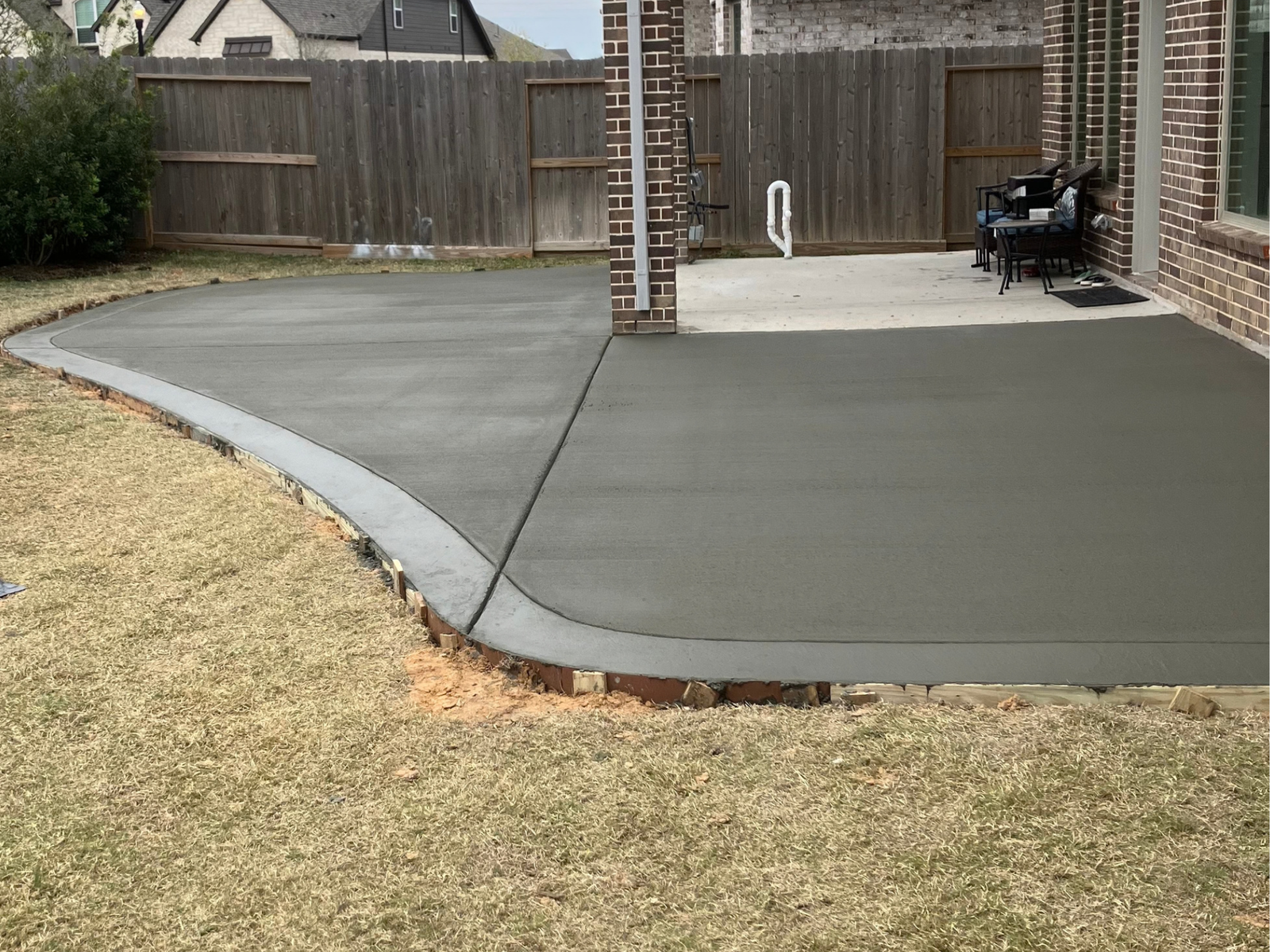
Sun exposure deserves just as much thought as square footage. A west facing patio in July can turn into a skillet by four in the afternoon, especially with our summer stretch of 100 degree days. A patio cover, a pergola, or a well-placed shade tree can make the difference between a space you use every evening and one you only see through the window. Lighter concrete colors also help here, since dark surfaces absorb far more heat and can become genuinely uncomfortable underfoot on a bright afternoon.
We build far more than back porch squares. Popular patio projects in this area include pool decks, outdoor kitchens, walkways connecting the patio to a side gate or driveway, covered seating areas, and fire pit patios for the six weeks a year Texas actually feels like fall. Pool decks get special attention, since a rough, light-colored, textured finish stays cooler and safer underfoot than a smooth dark one, which matters when there are bare feet and pool water involved. If you already have a patio but it’s stained, faded, or just outdated, a thin decorative overlay can often transform the surface without the cost or mess of removing the old slab entirely, as long as the concrete underneath is structurally sound.
Just like driveways, patios need joints placed with intention, not as an afterthought. We plan joint locations around the shape of the space, tucking them into corners or along natural lines where possible, so the finished patio looks clean rather than crisscrossed with random cuts. We also tie new patio sections into existing slabs with steel dowels when we’re expanding an existing space, so the old and new sections move together instead of separating over time.
Where We Pour: Fulshear and the Towns Around It
Our crews work throughout Fulshear, including newer neighborhoods like Cross Creek Ranch, Jordan Ranch, and Tamarron, where plenty of homes are still working with a builder’s basic slab. We also handle driveway and patio projects out toward Katy and Cinco Ranch, where the mix of established neighborhoods and newer construction near Katy Mills keeps demand steady for both replacements and fresh installs.
Ready for a Driveway or Patio Built to Last?
Toward Richmond and Pecan Grove, near George Ranch Historical Park, older homes often need driveway replacement more than new installation, since original slabs from decades past have had plenty of time to wear out, crack, or settle unevenly.
We also serve Rosenberg, Sugar Land, and the smaller communities of Simonton and Brookshire, where larger lots often mean longer driveways, bigger patios, and occasionally a request for something a little more ambitious than the standard rectangle out back.
A good driveway should handle everything your family throws at it, from the daily commute to the occasional moving truck, without a second thought.
A good patio should be the place you actually want to sit down, not just a slab you walk across on the way to the yard.
Churchill Concrete builds both with the same attention to base work, drainage, and finish that keeps concrete looking good and performing well for decades in this climate.
Call Churchill Concrete today at (281) 201-0262 or request your free quote online to get started on your driveway or patio project.
We proudly serve Fulshear, Katy, Richmond, Rosenberg, Sugar Land, Simonton, Brookshire, and the surrounding area.
Complete This for Your Free Estimate!
Common Questions from Customers
A broom finish is the most common and budget-friendly choice, and it provides excellent traction for vehicles in wet weather. Stamped concrete and exposed aggregate cost more but offer a more custom look, and both can still be finished with enough texture to stay safe when wet.
Most home driveways should be at least 4 inches thick. If you regularly park a truck, trailer, RV, or boat, 5 or 6 inches gives the slab enough strength to handle that extra weight without stressing the concrete or the base underneath it.